
Reclaimed wood safety begins before a blade touches the board. Old lumber can offer useful character and reduce demand for new stock, but its history may include metal, coatings, chemicals, decay or exposure you cannot identify from its surface.
Treat every batch as material to assess, not automatically free project lumber. Set aside anything with an uncertain treatment or contamination history instead of sending it through a saw or planer to find out.
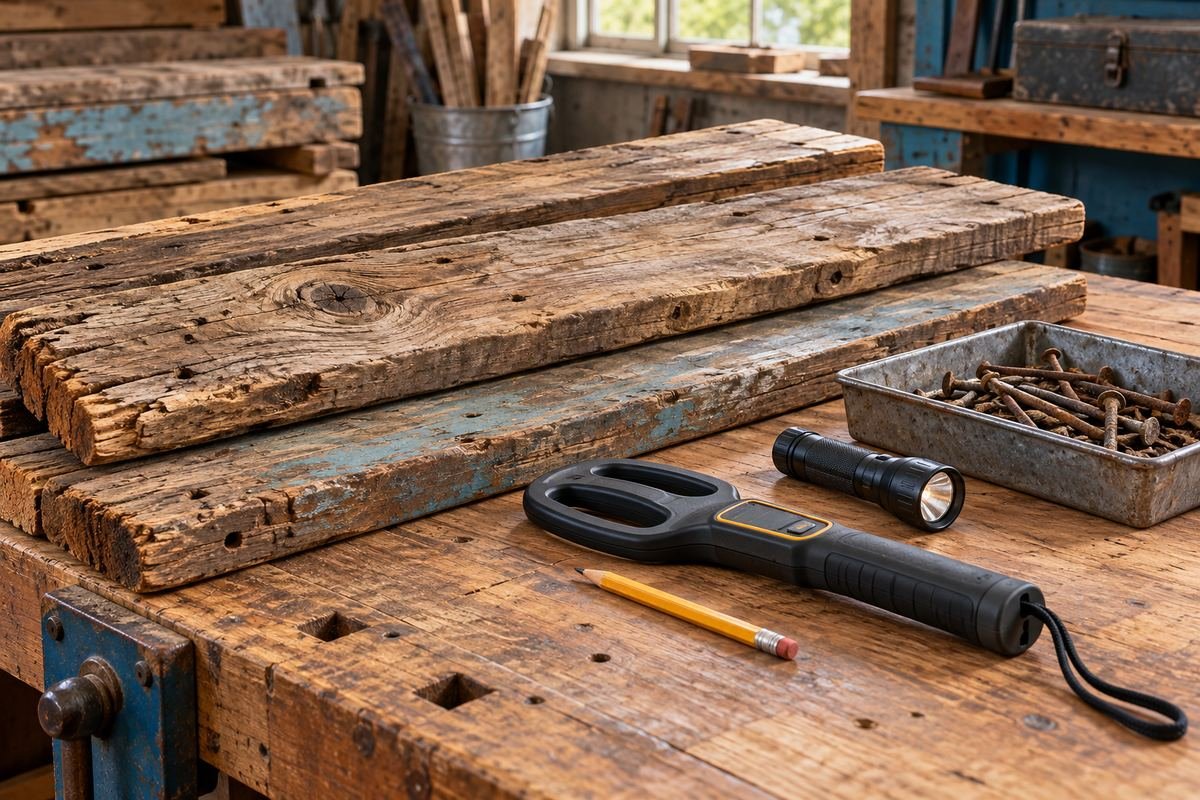
Reclaimed wood safety: accept, investigate or reject
Create three groups before cleaning or machining: material with a known suitable history, material needing further assessment, and material you will not use. Keep the groups labeled and separate. A metal detector is one inspection aid; it does not certify the wood as free of every hazard.
1. Record where the wood came from
Ask what the boards were used for, where they were stored and whether they were painted, treated or exposed to chemicals. Keep any available documentation with the batch. A weathered appearance does not identify the species or treatment.
For pallets, building salvage and outdoor timbers, markings and a seller’s description can provide clues but are not a complete contamination assessment. Choose material with a history appropriate to its intended use. Do not turn unidentified industrial stock into a food-contact project simply because the surface can be sanded.
2. Investigate coatings before disturbance
Paint, adhesive, finish and residue can create hazards when cut or sanded. Older building materials may contain lead-based paint or be associated with other hazardous materials. Check the source and obtain the appropriate assessment before disturbing them.
EPA’s discussion of reusing lead-painted building materials does not mean sanding them in a home workshop is an acceptable preparation method. Reclaimed wood safety depends on the actual material and work process. If the coating cannot be identified and managed appropriately, choose different stock.
3. Remove visible hardware without hiding it
Inspect all faces and ends under good light. Look for nails, screws, staples, broken fasteners and plugs that may conceal hardware. Secure the board before removal and use suitable hand tools and handling protection for the task.
Mark areas where a fastener broke off. Do not hammer a nail deeper and then forget its position. Store removed hardware in a container and keep it away from ready-to-machine lumber. Recheck the board after handling because dirt or old coating may hide additional clues.
4. Use metal detection as an aid, not a guarantee
Follow the detector’s instructions, check its operation with a known sample and scan the relevant surfaces in a controlled pattern. Sensitivity, metal type, depth and nearby hardware can affect the response. Keep the board away from a metal bench or other interference where the instructions require it.
Investigate signals rather than assuming they are harmless. No signal is not proof that every fastener is absent. If the stock’s geometry or contamination prevents a confident assessment, do not machine it. A damaged carbide tooth is not a sensible detection method.
5. Assess moisture and physical condition
Look for decay, major checks, splits, loose knots, insect damage and distortion. Decide whether enough sound wood remains after trimming. Use moisture information appropriate to the species and intended environment, rather than treating dry-looking surfaces as ready for furniture.
Allow suitable acclimation and plan final machining around the project’s requirements. Insect concerns may need specialist advice; moving wood can also spread pests. Do not improvise an indoor heat-treatment method or rely on a household oven to make questionable lumber suitable.
6. Plan the cut around a sound reference
Once the batch is suitable, determine how each piece can be supported and guided. A warped board without a stable reference surface may not be appropriate for an ordinary rip against a table-saw fence. Cutting capacity does not establish workpiece stability.
Use a suitable preparation method and complete procedure for the condition. Check that the blade is approved for the material and that all required guards and supports remain in place. Reclaimed wood safety includes stock control, not just detecting nails.
7. Match the reuse to what you actually know
Decorative shelving, a shop fixture, food contact and structural construction have different requirements. Attractive old lumber is not automatically structurally graded, uncontaminated or suitable for an indoor surface. Do not infer load capacity from thickness alone.
Price the usable yield after defects, trimming, cleanup and assessment. Sometimes new stock is the better choice for a demanding application. Keep the character pieces for a project whose material requirements they can meet.
Keep a batch record through the project
Label the source, inspection date, unresolved concerns and intended use. Mark detected metal locations and rejected sections. Keep photographs before the original surface or markings disappear during preparation.
A batch record helps another person understand what has been checked and what remains uncertain. Reclaimed wood safety is easier to maintain when the information follows the board instead of staying in someone’s memory.
Questions readers ask
Does a clean metal-detector scan make a board safe to plane?
No. It is only one check. Metal can be missed, and the scan says nothing about coatings, decay, chemical contamination or workpiece stability.
Can I sand unknown paint off reclaimed boards?
Do not start by sanding. Identify the coating and establish appropriate controls first, or select different material.
Is old wood automatically better for a structural project?
No. Structural suitability requires the relevant grading and design assessment. Age and appearance do not establish strength or permitted use.
Save useful material without guessing at its history
Use the reclaimed wood safety checklist before investing time in machining. Known origin, assessed coatings, hardware inspection and stable stock provide a better starting point than a promising rustic surface.
Sources and editorial approach
Published October 2026. This article combines the primary sources below with original explanatory examples and practical analysis. It does not claim hands-on product testing. The cover is an original AI-generated editorial illustration, not a product test photograph. Follow the exact equipment instructions for operation.
EPA: deconstruction and reuse of lead-painted materials
USDA Forest Products Laboratory: framing lumber from building removal