
Dust extractor vs shop vac is a system comparison, not just a choice between a box-shaped machine and a round tank. Both use a motor and filter to collect material, but their intended tasks, controls, filtration arrangements and tool connections can differ.
For woodworking, begin at the dust-producing tool and follow the path through its port, hose, collection container, filter and exhaust. A powerful vacuum with a poor connection may capture less at the source than you expect.
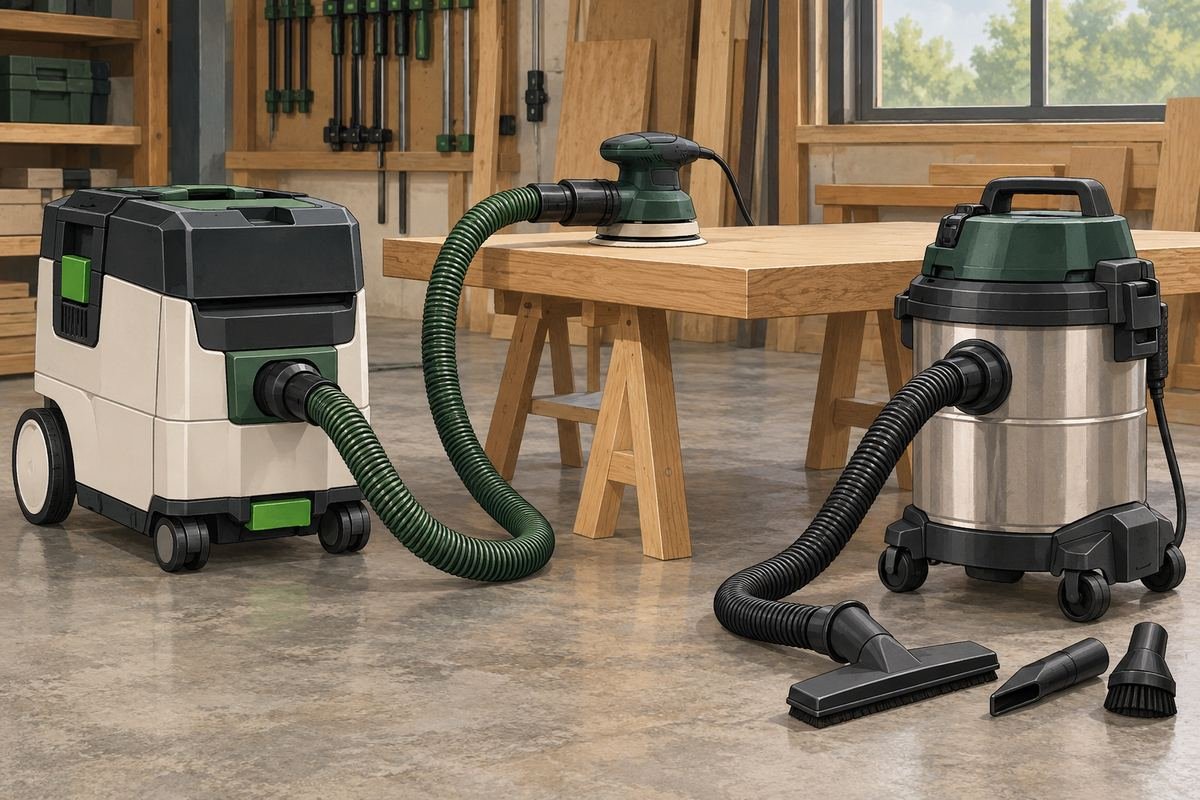
Dust extractor vs shop vac: start at the tool port
Check what the saw or sander requires, then compare a complete compatible collection setup. Do not assume a HEPA replacement filter converts any general-purpose vacuum into a sealed HEPA system or establishes suitability for hazardous material.
1. Define the job before the machine category
Floor cleanup, small-port sander extraction and collecting large volumes of planer chips are different tasks. Write down which tools you use, the materials involved and whether collection occurs during cutting or afterward.
A compact vacuum-based system may suit small tool ports. A machine requiring much higher air volume through a large duct needs an appropriately designed collector. In a dust extractor vs shop vac decision, neither label alone establishes the required airflow at your tool.
2. Check the complete filtration arrangement
Read the manufacturer’s description of the machine, filter, seals and collection bag together. A filter’s performance is only one part of the path. Leaking seals, incorrectly fitted filters or the wrong bag can undermine the intended system.
For lead, asbestos, silica or other hazardous material, use the specific required controls and qualified guidance. Do not treat a woodworking purchase comparison as a compliance plan. Investigate the material before collecting dust, especially during renovation.
3. Compare airflow where the work happens
An advertised airflow figure may be measured under conditions unlike your setup. Hose diameter and length, bends, adapters, loaded filters and the tool shroud all affect the result. Compare the manufacturer’s data and intended application, not just the largest headline number.
Check connections for secure fit and leaks. Avoid restricting a tool’s required airflow with a convenient but unsuitable narrow adapter. A hose that fits physically is not proof that the collection performance is adequate.
4. Understand filter-cleaning features
Some extractors include automatic or manual filter-cleaning systems to help maintain airflow during suitable dry work. The feature, interval and approved materials vary. It does not eliminate filter inspection or correct collection-bag use.
A general-purpose vacuum may need a different maintenance routine. Follow the manual instead of knocking a filter against the bench or blowing fine dust into the room. Include replacement filters and bags in the operating cost.
5. Compare tool activation and power supply
An extractor may provide a tool-triggered outlet, remote control or wireless start feature. Verify the exact model and compatibility. Check outlet limits and circuit loading before connecting a corded saw and vacuum together.
Automatic start is convenient, but it does not compensate for weak capture. Plan hose and cable routing so neither pulls a sander, catches a rail or blocks an emergency stop. Cordless tools may need a different activation method from plug-in tools.
6. Treat separators and air cleaners as different tools
A compatible pre-separator can collect some material before it reaches the filter, but it can also add hose, restriction and maintenance. Verify the combined arrangement rather than assuming every cyclone improves every small-port task.
An ambient air cleaner addresses airborne particles after release; source capture aims to collect them where generated. One is not a universal substitute for the other. Do not use a clean-looking room or the absence of visible dust as proof that exposure is controlled.
7. Compare total cost and daily handling
Include the approved filter, bags, hose, tool adapters and necessary controls. Check storage footprint, noise information, hose management and whether the unit is convenient to empty using its prescribed procedure.
For occasional nonhazardous cleanup, a suitable general-purpose vacuum may meet the task. For frequent connected-tool work, an extractor’s integrated controls and collection arrangement may save repeated setup. This dust extractor vs shop vac comparison depends on the complete job, not brand prestige.
Build a maintenance card for the system
Record the tool, port adapter, hose, bag and filter part numbers. Add the inspection and replacement instructions. Check for clogged hoses, damaged seals and a container filled beyond its limit before blaming the motor.
Collect and dispose of dust using the permitted method. Keep ignition sources and inappropriate debris out of the system, and never collect hot embers or flammable liquids in a machine not designed for them. For workplace exposure questions, seek a proper assessment of the process.
Questions readers ask
Does a HEPA filter make any vacuum a HEPA vacuum?
No. Check the manufacturer’s rating for the complete system and its approved filter and collection configuration.
Is more CFM always better?
The airflow must suit the tool and remain adequate through the real hose and filter arrangement. A headline rating alone does not establish capture at the cutting point.
Can I use one machine for wet pickup and fine dust?
Only where the machine permits both, following its different filter, bag and preparation procedures. Do not assume the dry-dust configuration is ready for liquids.
Compare the path from tool to exhaust
Use these dust extractor vs shop vac checks to select a complete, maintainable system. Improve the source connection and support it with correct filters, collection and maintenance rather than buying on motor size alone.
Sources and editorial approach
Published October 2026. This article combines the primary sources below with original explanatory examples and practical analysis. It does not claim hands-on product testing. The cover is an original AI-generated editorial illustration, not a product test photograph. Follow the exact equipment instructions for operation.
OSHA: wood-dust control resources