
A flesh sensing table saw can tell the difference between a board and a fingertip, then stop the blade before a slip becomes a life-changing injury. For years only one brand sold this technology in the U.S. In 2026 that picture is shifting, with key patents expiring and federal regulators stepping back from a mandate. Here is what the technology does, what it does not do, and how to think about it before your next saw purchase.
- A flesh sensing table saw uses a small electrical signal on the blade and a fast brake or retraction system to limit blade-contact injuries.
- The CPSC withdrew its proposed mandatory table saw rule in 2025, so the technology remains optional in the U.S.
- Several long-running patents in this field reach the end of their terms around 2026, which could open the door to more brands.
- No flesh sensing system prevents kickback. Riving knives, guards, push sticks and good technique are still essential.
What is a flesh sensing table saw?
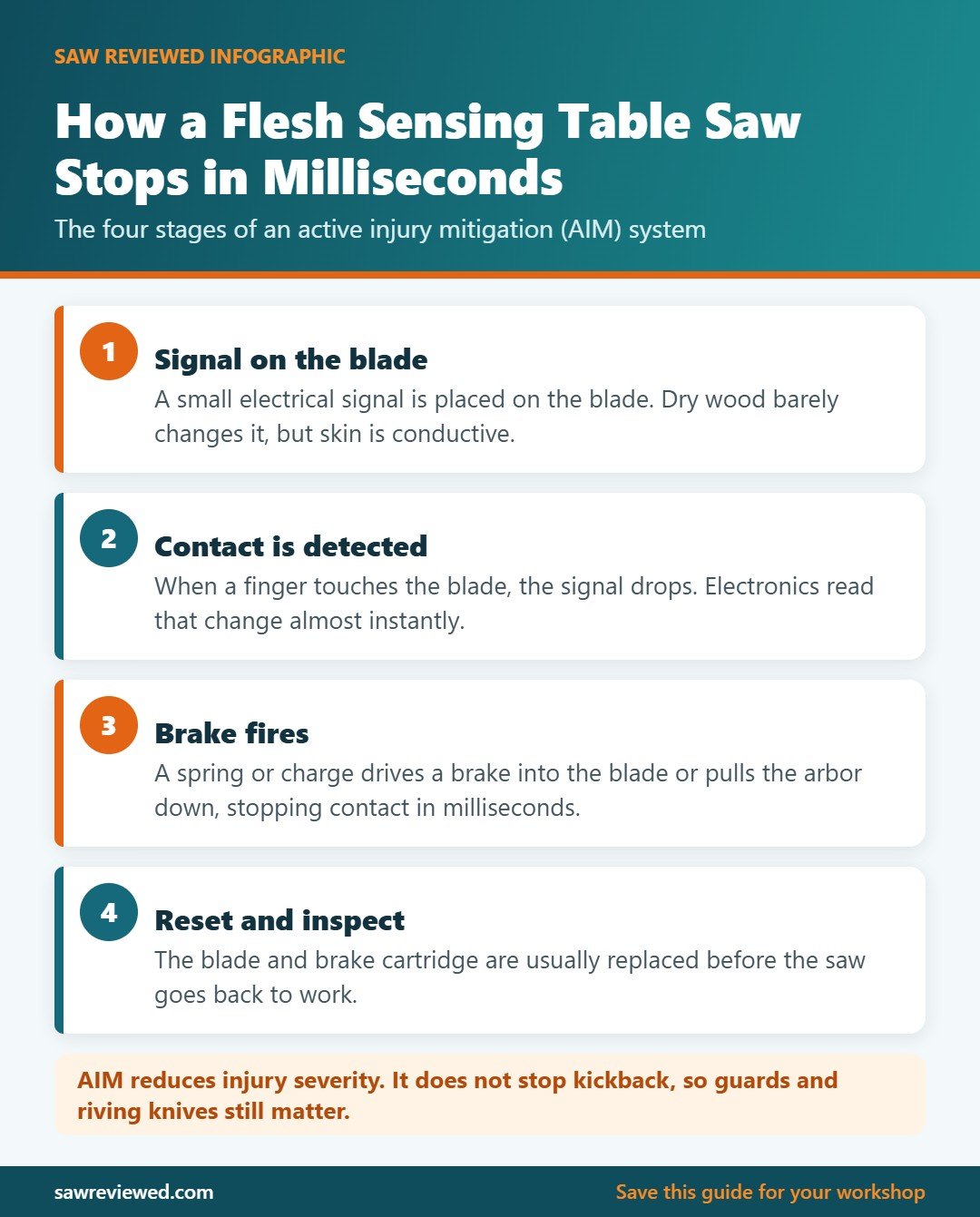
A flesh sensing table saw is a table saw with an active injury mitigation system, often shortened to AIM. Traditional safety features such as blade guards and riving knives are passive: they try to keep your hand away from the blade. AIM is different. It assumes contact might happen and reacts in the few milliseconds after it does.
The best-known example uses a brake that slams an aluminum block into the spinning blade while the blade assembly drops below the table. Bosch tried a different approach with its REAXX saw, which retracted the blade without destroying it, but that saw was blocked from import into the U.S. after a patent dispute. Other designs exist in Europe, including systems that sense a hand approaching before it touches.
How the detection works
Wood is a poor electrical conductor when it is reasonably dry. Human skin is a much better one. A flesh sensing table saw puts a small, harmless signal on the blade and continuously measures it. When skin touches the teeth, some of that signal flows into your body and the measured value changes sharply. Electronics compare the change against a threshold and fire the brake.
This is also why very wet lumber, green wood, conductive materials and some foil-faced products can trigger a false activation. Most systems include a bypass mode for those materials. Using bypass means you have a normal table saw for that cut, so slow down and use every passive safety tool you have.
Why 2026 matters: patents and regulation
The patent picture
The first flesh sensing table saw patents date back to the early 2000s. Patents generally last 20 years from filing, but continuation patents can stretch protection for specific features much longer. The Power Tool Institute has noted that one key patent covering blade retraction expires in 2026, and woodworking forums have tracked the last continuation patents reaching their end around the same time.
Patent expiry does not automatically put new saws on shelves. Manufacturers still need to engineer, test and certify their own systems, and some companies may design around remaining claims. Expect a gradual change rather than a flood.
The regulatory picture
The U.S. Consumer Product Safety Commission proposed a mandatory performance standard in 2017 that would have effectively required AIM on new table saws. After years of debate, the Commission withdrew that proposal, as recorded in the Federal Register in September 2025. In practical terms, buying a flesh sensing table saw is still a personal choice, not a legal requirement.
7 essential facts before you rely on AIM
- It limits injury, it does not prevent it. Most activations still leave a small cut. That is far better than an amputation, but it is not zero.
- Kickback is a separate hazard. A flesh sensing table saw does nothing to stop a board being thrown back at you. A riving knife and anti-kickback pawls address that risk.
- Activations cost money. You will usually need a new brake cartridge and often a new blade. Budget for spares.
- Wet or conductive stock needs care. Check moisture and use bypass mode only when you must.
- Dado blades need special cartridges. Stacked dado sets often require a different brake and insert.
- Guards still matter. CPSC staff have reported that blade-guard removal is common because of visibility. Keeping the guard on is still the first line of defense.
- Technique matters most. Push sticks, featherboards and a clean fence setup prevent the slips that lead to contact in the first place.
Flesh sensing vs. passive table saw safety
| Feature | What it protects against | Limitations |
|---|---|---|
| Blade guard | Accidental hand contact from above | Often removed for visibility |
| Riving knife | Kickback from the kerf closing | Must match blade thickness |
| Anti-kickback pawls | Board being pulled back toward you | Can mark soft stock |
| Push sticks and blocks | Hands near the blade on narrow rips | Only work if used every time |
| Flesh sensing table saw brake | Severity of blade contact | Cost of activation, no kickback protection |
The best setup layers all of them. Our guide to table saw features and safety systems explains how each part fits together.
Is a flesh sensing table saw worth it for a home shop?
For many hobbyists, the answer comes down to risk and budget. If you cut often, share the shop with less experienced users, or teach family members, the extra cost of a flesh sensing table saw can be easy to justify. If you mostly rip a few boards a year, a well-tuned conventional saw with a riving knife, a good guard and disciplined technique may be enough.
Before you decide, read our list of common table saw mistakes. Most of them, from freehand cuts to standing in line with the blade, lead to injuries that AIM technology cannot fully solve. If you are comparing models, our table saw buying guide and cabinet table saw guide cover capacity, fence quality and dust collection.
What to watch for in the next two years
As more patents lapse, look for three things: new brands announcing their own blade-contact systems, lower prices on entry-level flesh sensing table saw models, and systems that stop the blade without destroying it. Also watch for retrofit products. A safety system that bolts onto an existing saw would be a big deal for the millions of conventional saws already in garages, but any such product will need independent testing before you trust it.
FAQ
Does a flesh sensing table saw work with gloves?
Gloves can prevent detection because the fabric is not conductive, and loose gloves near a blade are a hazard in their own right. Most manufacturers advise against wearing gloves at the table saw.
Will wet wood trigger the brake?
It can. Very wet or green lumber may be conductive enough to cause an activation. Use the saw’s moisture test or bypass mode as the manual describes.
Is a flesh sensing table saw required by law?
No. The proposed CPSC rule was withdrawn in 2025. Workplace guarding rules still apply under OSHA.
Can I add flesh sensing to my current saw?
Not with any widely tested product at the time of writing. Treat any retrofit claim with caution until independent testing is available.
A flesh sensing table saw is one of the most important safety advances in woodworking, but it works best as the last layer of protection, not the first. Keep the guard on, use a riving knife and push sticks, and let the technology catch the mistake you hope never happens.