
Cold weather tool batteries feel like they die twice as fast in January, and that is not your imagination. Lithium-ion chemistry slows down as temperatures drop, so the same pack that cut 40 studs in July may quit after 20 on a frosty jobsite. The good news: most winter runtime loss is temporary, and the damage that is permanent is almost always avoidable with a few simple habits.
- Cold reduces available power and runtime, but the loss is mostly temporary once the pack warms up.
- Never charge a lithium-ion battery that is below freezing; warm it to room temperature first.
- Store packs indoors at partial charge and rotate a warm spare on the jobsite.
- High-drain saws feel the cold first, so plan cuts and battery swaps around them.
Why cold weather tool batteries lose power
Inside every cordless pack, lithium ions move through a liquid electrolyte between two electrodes. When the temperature falls, that electrolyte thickens and the ions move more slowly. Internal resistance rises, voltage sags under load, and the battery management system sees that sag as an empty pack. The tool shuts off even though energy is still stored in the cells.
That is why a drill driving small screws may seem fine in the cold while a circular saw or reciprocating saw stalls quickly. High-current tools pull the voltage down further, so they hit the low-voltage cutoff sooner. According to Battery University, the capacity lost at low temperature returns once the cell warms back up, which is why a pack that “died” outside often shows two bars after an hour on the kitchen counter.
The one rule you should never break: charging when frozen
Using a cold battery is mostly a performance problem. Charging a cold battery is a damage problem. When lithium-ion cells are charged below freezing, lithium can deposit as metal on the surface of the anode instead of sliding into it. This plating is permanent, reduces capacity and can make the cell less stable over time.
Most modern chargers from major brands include a temperature sensor and will show a “hot/cold pack delay” light instead of charging. Do not try to trick that delay. If you see it, bring the battery inside and wait.
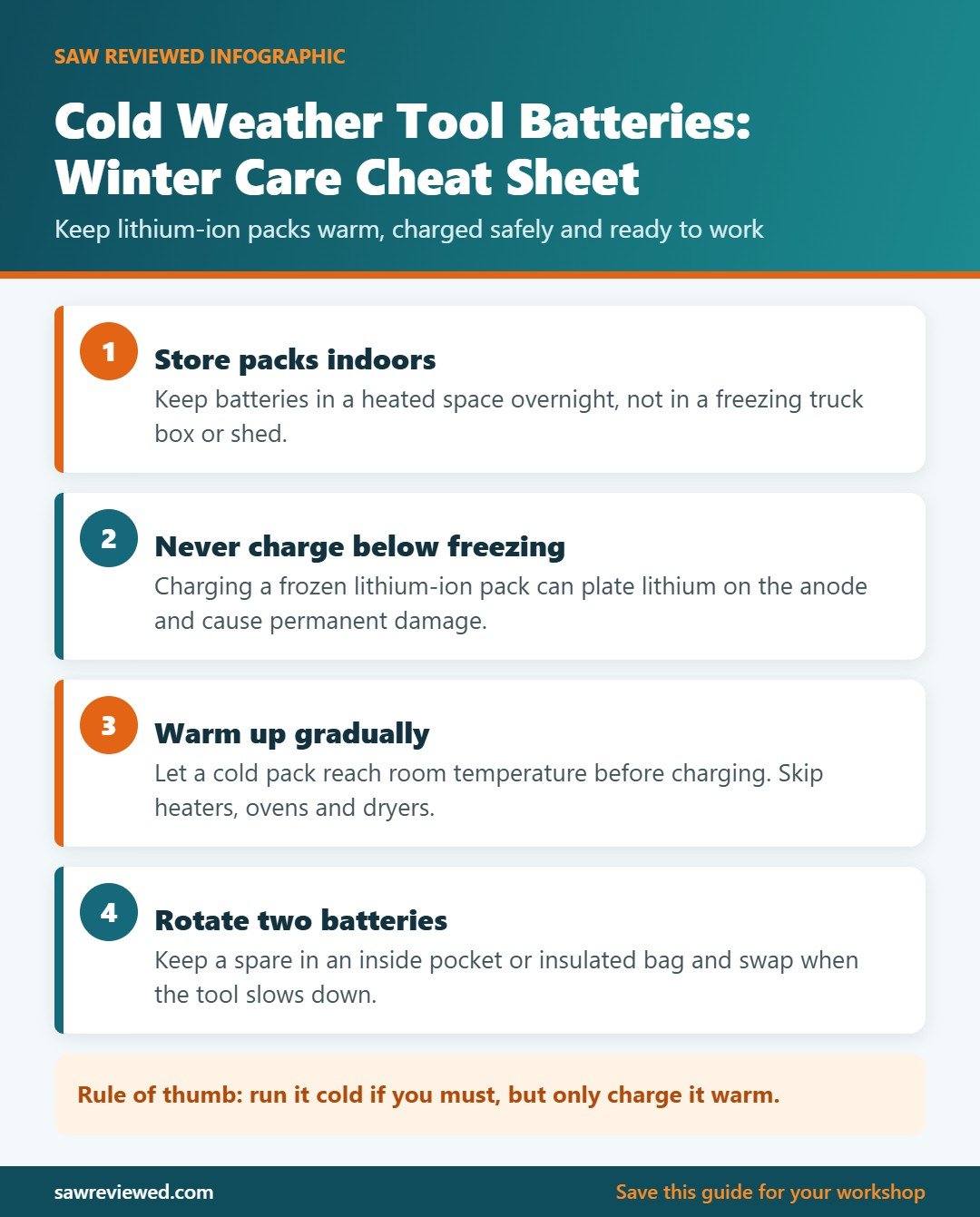
9 winter rules for cold weather tool batteries
These habits come from how lithium-ion chemistry behaves, not from any single brand manual, so they apply to DeWalt, Milwaukee, Makita, Ryobi, Bosch and every other platform. Always check your own manual for exact limits.
- Store packs inside overnight. A truck toolbox can drop well below freezing. Bring batteries into the house or a heated shop at the end of the day.
- Charge only at room temperature. Let a cold pack sit indoors until it no longer feels cool to the touch before you plug it in.
- Keep a warm spare. An insulated lunch bag or an inside jacket pocket keeps a second battery close to body temperature.
- Swap early on heavy cuts. When a saw starts to bog down, change packs instead of forcing it to the cutoff point.
- Use the biggest pack for saws. Higher-capacity batteries contain more cells in parallel, so each cell carries less current and voltage sag is lower.
- Avoid deep discharge in the cold. Running a frozen pack to zero stresses weak cells. Stop at the first sign of slowdown.
- Store at partial charge. For long winter storage, about 40 to 60 percent charge in a cool, dry, above-freezing space is ideal.
- Keep terminals dry. Snowmelt and condensation can corrode contacts. Wipe packs before inserting them into tools or chargers.
- Inspect after a hard freeze. Swelling, cracks, rattles or a pack that heats up while idle should be retired and recycled.
How winter affects different cordless tools
Not every tool reacts to cold in the same way. The bigger the current draw, the more obvious the drop in performance. Use this table to plan which jobs to do first when the batteries are warm.
| Tool type | Cold sensitivity | What you will notice | Best winter strategy |
|---|---|---|---|
| Circular saw | High | Bogging in thick lumber, early cutoff | Use a large pack, swap at first slowdown |
| Reciprocating saw | High | Weaker strokes in demolition | Keep two warm packs in rotation |
| Miter saw | Medium-high | Fewer cuts per charge | Run from a heated garage when possible |
| Impact driver | Medium | Slower driving of long screws | Pre-drill and keep a spare handy |
| Drill/driver | Low-medium | Mostly normal for light work | Standard pack is usually fine |
| LED work light | Low | Slightly shorter runtime | Any compact pack works |
If you are still choosing between platforms, our corded vs. cordless circular saw comparison explains when a cord is simply the better winter choice.
Battery size, watt-hours and winter runtime
Amp-hours tell you capacity, but watt-hours give a fairer comparison across voltages. A 20V max (18V nominal) 5Ah battery holds about 90 watt-hours, while a 2Ah compact holds about 36. In the cold, that difference matters more than the label suggests because the smaller pack sags harder under load. Our guide to battery watt hours for cordless saw buyers shows how to compare packs before you buy.
Storing cold weather tool batteries during the off-season
If you put your outdoor tools away for winter, the batteries need different care than the tools. Remove packs from string trimmers, chainsaws and leaf blowers. Charge each one to roughly half, then store it in a dry space that stays above freezing. A closet or basement shelf is better than an unheated shed.
Check stored cold weather tool batteries every couple of months. Lithium-ion self-discharge is slow, but a pack left completely empty for months can drop below the voltage at which the charger will accept it. Our winter tool storage guide covers the rest of the shop, from rust prevention to blade care.
Signs your battery was damaged by the cold
Most winter complaints are temporary, but watch for patterns that point to real damage. A pack that never recovers full runtime after warming up, one that charges much faster than it used to, or one that flashes an error on several chargers may have weak or plated cells. Some platforms show battery health in an app or on the charger; use it if you have it.
Replacing a damaged pack is cheaper than replacing a tool, and much cheaper than a fire. If you are rebuilding your kit, our cordless reciprocating saw comparison is a good starting point for matching tools to the battery platform you already own.
FAQ
Is it OK to leave tool batteries in a cold garage?
Short-term storage in a cold garage will not usually harm a pack, but do not charge it there while it is below freezing. For overnight and long-term storage, a heated space is better for cold weather tool batteries.
How cold is too cold to use a cordless tool?
Most packs can discharge well below freezing with reduced runtime. Check your manual, but expect noticeably weaker performance below about 20°F and plan more frequent swaps.
Can I charge a battery in my truck in winter?
Only if the battery and charger are warm. A battery that has been sitting in a frozen cab should warm up first. Many chargers will refuse to start until the pack is in range.
Do cold batteries recover their capacity?
Yes. Temporary capacity loss from cold returns when the battery warms up. Permanent loss usually comes from charging while frozen or deep-discharging a cold pack.
Treat cold weather tool batteries like you treat your own hands in winter: keep them warm between jobs, do not force them, and give them time before the next charge. Do that and your packs will last for many seasons.