
Track saw vs circular saw is a useful comparison when you want clean plywood cuts without dedicating a garage to a large stationary machine. Both can move the tool over supported stock, but the guide, plunge mechanism and setup workflow differ.
For occasional straight cuts, a compatible circular saw and clamped guide may do the job. For repeated panel work, a track-saw system can simplify alignment and source extraction. Choose around the complete workflow rather than the promise of a perfectly straight cut.
Track saw vs circular saw: the quick decision
Keep an existing circular saw if its capacity, blade and supported guide setup meet your projects. Consider a track saw when repeated sheet cuts, controlled entry or an integrated rail workflow save enough setup time to justify the full system cost.
1. Start with the material you can support
A full sheet of plywood is awkward even when the saw is compact. Plan a flat support arrangement, secure the stock and keep the entire underside blade path clear. Neither a track nor a straightedge prevents the offcut from sagging and pinching the blade.
Draw your typical cut on the actual sheet size. Check where the operator stands and where the saw, cord and hose finish. This is the first track saw vs circular saw test: can the complete cut happen without overreaching or moving the work mid-cut?
2. Compare the guide interfaces
A conventional circular saw follows a straightedge with the shoe beside it. You need the correct shoe-to-blade offset, sufficient clamp clearance and a guide that does not move. A saw and rail designed as a system use a matching interface; some circular saws also accept approved rail adapters.
Do not assume every rail, clamp or adapter is interchangeable. Check the exact combination. A compatible system can reduce repeated offset measurement, while a sound straightedge remains useful for straightforward occasional cuts.
3. Check entry and depth control
Many track saws are plunge-cut designs, but rail compatibility and plunge capability are separate features. A normal guarded circular saw is not converted into a plunge saw by placing it against a guide. Follow the actual tool’s approved starting and cutting procedure.
Account for rail thickness when setting depth. Check available depth at the bevel angle you need, not just at zero degrees. The guide must support the saw at the beginning and end of the cut according to its instructions.
4. Prove the edge quality on matching scrap
Blade condition, tooth geometry, stock support and face orientation affect breakout. A splinter strip is a useful system feature, not a guarantee that every material will leave a finished edge. Fit and prepare it exactly as the rail maker directs.
Cut a scrap of the same panel and inspect both faces. Measure the finished width at both ends and along the middle. In a track saw vs circular saw comparison, that result is more useful than comparing two manufacturers’ unrelated clean-cut photographs.
5. Include the dust workflow
A close-fitting blade enclosure and compatible dust port can help collect dust at the source. The result still depends on the extractor, hose, seals, filter condition and material. Do not assume a hose attached to any saw captures every particle.
Route the hose so it does not snag the rail or pull the tool off line. Check suction compatibility and tool instructions. Dust extraction is one part of the setup; it does not remove the need to assess the material and use appropriate protection.
6. Compare a usable package
Price the saw, suitable rail length, required connectors, clamps, blade, extraction connection and power system. A short starter rail may not support your longest cut. Joined rails need alignment and the correct hardware.
Use an example project to count setup steps. If you make two shelves a year, the savings may be modest. If you repeatedly break down cabinet panels, fewer guide-offset adjustments may matter. This makes track saw vs circular saw a workflow calculation rather than a contest over the tool-only price.
7. Keep the cuts each system does well
A circular saw remains useful for rough framing and other approved cuts where a rail is inconvenient. A track system can suit controlled panel breakdown and repeatable layouts. Neither replaces every table-saw rip or miter-saw crosscut arrangement.
Choose the system you can support and control, then add another tool only when it solves a repeated limitation. Avoid buying a rail system to compensate for an unsafe support surface or a blade that does not match the material.
A simple before-you-buy trial
Write down one typical panel size, required cut, visible face and finished tolerance. Set up the existing saw safely, make a scrap cut and record the setup time and result. Then compare the proposed rail system’s capacity and procedure against that same job.
Keep the trial realistic: include cleanup, guide positioning and storage. A track saw vs circular saw decision is easier when it is based on the work you actually repeat.
Questions readers ask
Does a track saw replace a table saw?
It can handle many panel cuts, but repeated narrow ripping and some guided joinery use different setups. Compare the whole project, stock handling and precision needs.
Can a circular saw use a track?
Some models use approved rails or adapters. Check exact compatibility; a similar-looking rail is not proof of fit.
Which produces the cleaner cut?
Both can produce useful results with the right blade and support. Test matching material and inspect both faces rather than treating the tool category as a guarantee.
Choose the setup you will repeat confidently
Use these track saw vs circular saw checks to compare capacity, support and setup effort. Buy the complete workflow that fits your projects, and prove it on scrap before cutting expensive panels.
Sources and editorial approach
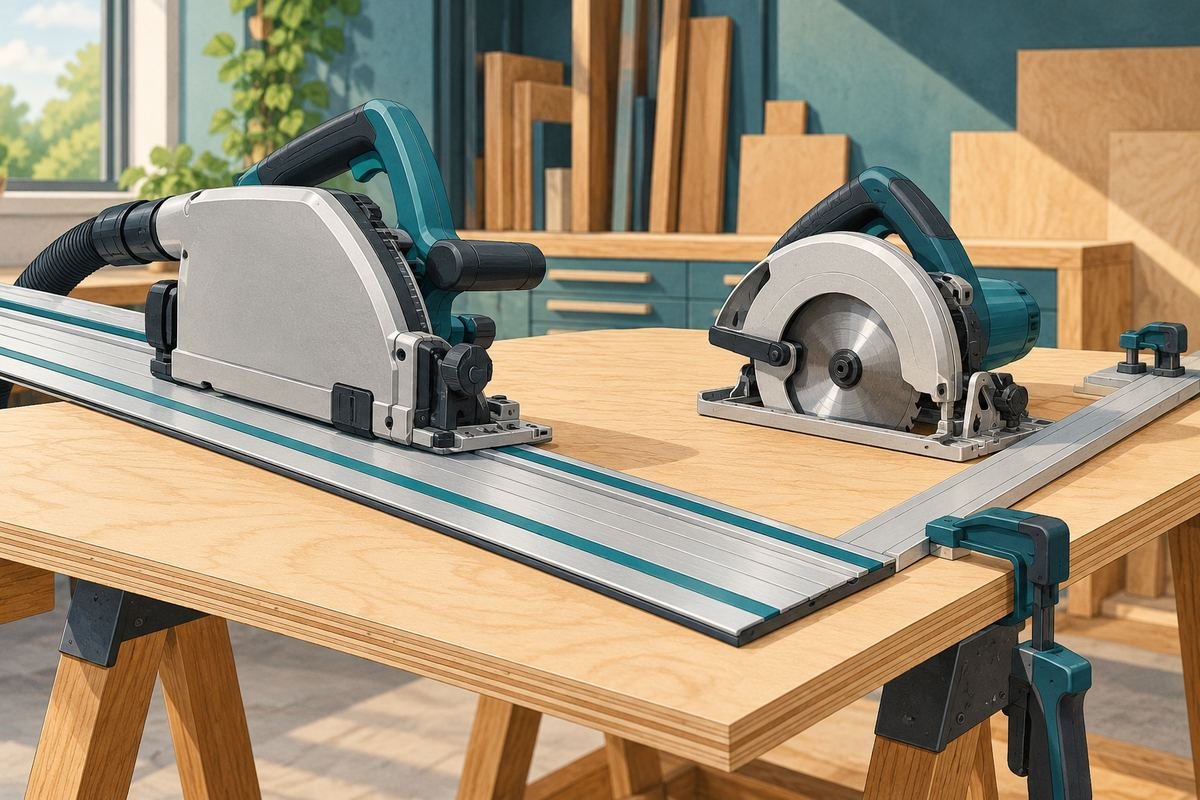
Published October 2026. This article combines the primary sources below with original explanatory examples and practical analysis. It does not claim hands-on product testing. The cover is an original AI-generated editorial illustration, not a product test photograph. Follow the exact equipment instructions for operation.
Festool: guide-rail system and compatibility