
A portable power station can turn a dead-quiet driveway, a remote cabin or a jobsite without power into a working shop. These battery-based units have grown from phone chargers into machines that can start a 15-amp miter saw. But plugging a hungry motor into the wrong unit will trip it instantly. This guide shows how to size a portable power station for corded saws and other power tools, without guesswork.
- A portable power station needs enough continuous output (running watts) and enough surge output to start motors.
- Battery capacity in watt-hours decides how long you can cut, not whether the saw will start.
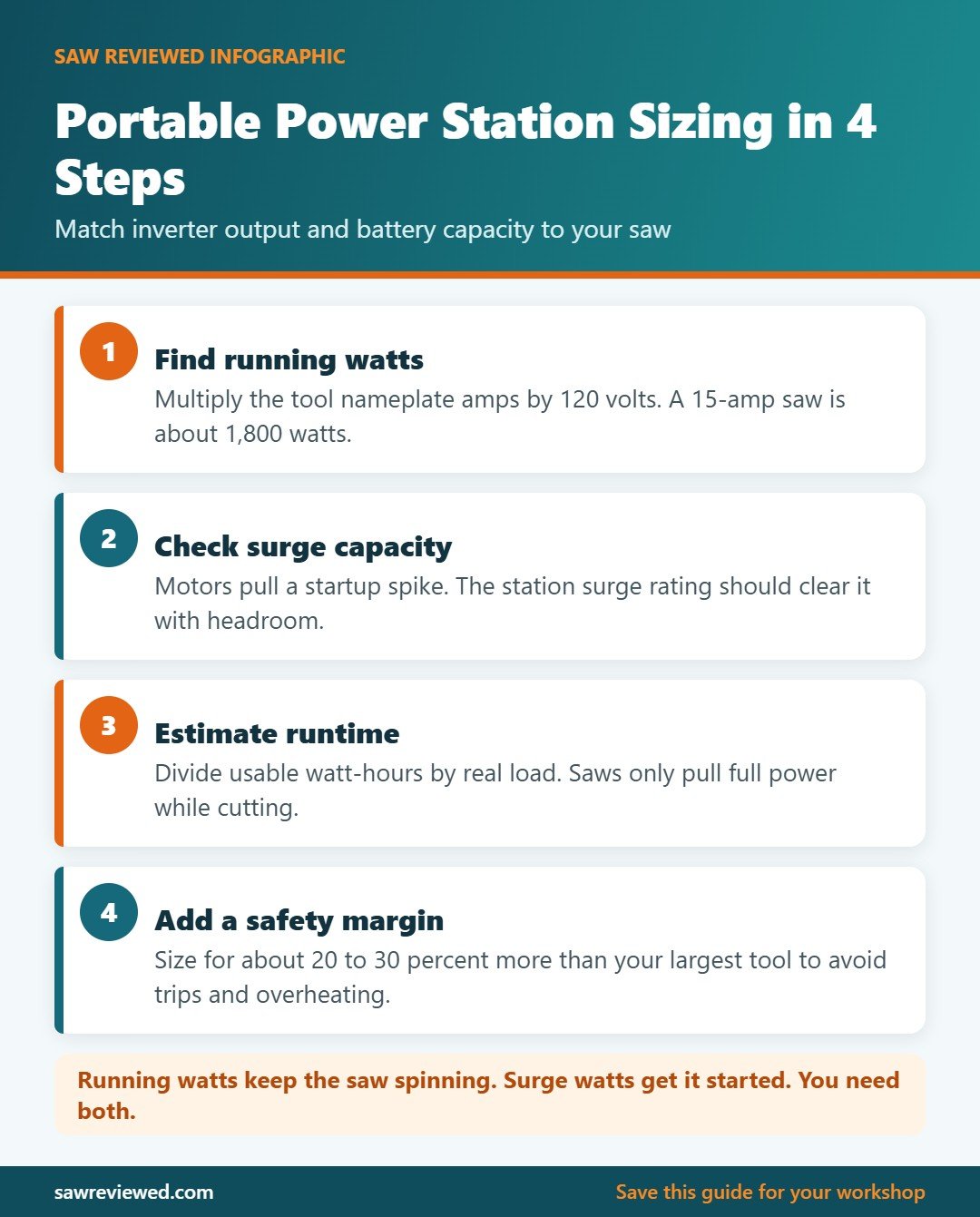
- Most 15-amp saws need roughly 1,800 running watts and a higher brief startup surge.
- Unlike gas generators, power stations produce no exhaust, so they can be used safely in a garage or workshop.
What a portable power station actually is
A portable power station is a large lithium battery, an inverter and a charge controller in one box. The battery stores energy, the inverter converts it to 120-volt AC like a wall outlet, and the controller lets you recharge from the wall, a car or solar panels. Most newer models use lithium iron phosphate (LFP) cells, which trade some weight for long cycle life and good thermal stability.
Because there is no engine, a portable power station makes no exhaust. That is the biggest safety difference from a gas generator. The CPSC warns that portable generators must never run inside homes or garages because of carbon monoxide. A battery station has no such limit, although it still needs ventilation for its cooling fans.
Running watts vs. surge watts
Every portable power station lists two output numbers. Continuous or rated output is how much power it can supply all day. Surge or peak output is how much it can deliver for a fraction of a second. Motors need that spike to get the blade spinning, especially saws with heavy blades.
To estimate a tool’s running watts, look at the nameplate. Multiply amps by 120 volts. A 15-amp miter saw is about 1,800 watts. A 10-amp jigsaw is about 1,200 watts. Many brands also offer surge-boost modes that lower voltage to let high-load devices run; these can help with heaters and kettles, but test carefully with motors because a saw running at low voltage can bog and overheat.
Which tools can a portable power station run?
| Tool | Typical nameplate | Approx. running watts | Station size to consider |
|---|---|---|---|
| Jigsaw | 5–7 A | 600–850 W | 1,000 W+ output |
| Corded drill | 6–8 A | 700–1,000 W | 1,200 W+ output |
| Circular saw | 13–15 A | 1,550–1,800 W | 2,000 W+ output with strong surge |
| Miter saw | 15 A | 1,800 W | 2,200 W+ output with strong surge |
| Jobsite table saw | 15 A | 1,800 W | 2,400 W+ output; test before relying on it |
| Shop vacuum | 8–12 A | 1,000–1,450 W | 1,500 W+ output |
These are estimates. Soft-start saws are much easier on a portable power station because they ramp up instead of spiking. Check the manual or spec sheet for soft start, which is common on many miter and table saws.
How long will it run? The watt-hour math
Capacity is listed in watt-hours. A 2,000 Wh station can, in theory, supply 1,000 watts for two hours. Real numbers are lower because of inverter losses, which often run 10 to 15 percent.
Here is the good news for woodworkers: saws do not draw full power all the time. A miter saw might cut for five seconds, then sit idle while you mark the next board. Twenty crosscuts might only use a few dozen watt-hours. A table saw ripping a sheet of plywood draws much more because the blade is under load for longer. Our battery watt hours guide explains the same math for cordless packs.
7 smart sizing rules
- Start with your biggest motor. Size continuous output for your hungriest tool, not the average one.
- Add 20 to 30 percent headroom. Running a station at its limit causes heat, fan noise and nuisance trips.
- Prefer pure sine wave output. Most quality stations provide it; avoid modified sine inverters for motor tools.
- Look for high surge ratings. A station rated 2,400 W continuous with a much higher surge is better for saws than one with little surge margin.
- Use short, heavy cords. Long thin extension cords drop voltage and make motors work harder.
- Run one big tool at a time. Do not run a table saw and a shop vac together unless the station clearly supports both.
- Recharge between sessions. Solar input is slow; plan for wall or vehicle charging on big project days.
Portable power station vs. cordless tools vs. generator
If you mostly cut on the go, cordless tools may be simpler. A couple of high-output batteries can handle a lot of trim and framing work, and our corded vs. cordless circular saw guide breaks down that trade-off. A portable power station makes most sense if you already own good corded tools, need quiet indoor power, or want backup power for the house as well as the shop.
A gas generator still wins for long, heavy days with several high-draw tools, but it brings noise, fuel storage and carbon monoxide risk. Battery stations win on silence, zero emissions and indoor use.
Caring for the battery
Store a portable power station at a moderate charge in a cool, dry place and top it up every few months. Avoid leaving it in a hot car or a freezing shed, and do not charge it below freezing. Many units let you set a charge limit, which can extend battery life if you mostly use it for backup. If you also run cordless tools, our tabless battery cells explainer covers the newest pack technology.
FAQ
Can a portable power station run a table saw?
Some larger units can, especially with soft-start saws. You need high continuous output, strong surge capacity and enough watt-hours for long rips. Test with your exact saw before depending on it.
Is a portable power station safe indoors?
It produces no exhaust, so it can be used indoors with normal ventilation. Keep it away from water and do not cover its cooling vents.
Will solar panels keep up with a saw?
Solar can recharge a portable power station over hours, but it will not usually keep pace with heavy saw use in real time.
Why does my station shut off when the saw starts?
The motor startup surge exceeded the station’s peak rating. Try a soft-start tool, a larger station or a lighter blade.
Size your portable power station around your biggest saw’s running and surge watts, then choose capacity for how long you work. Get those two numbers right and you will have quiet, clean power anywhere you build.