
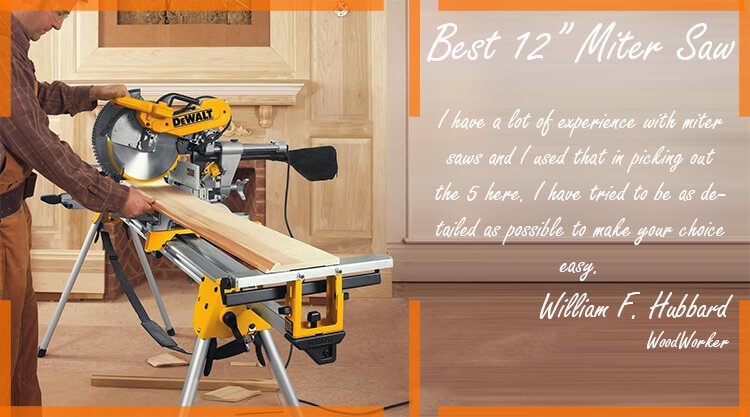
Affiliate disclosure: As an Amazon Associate I earn from qualifying purchases. Links below may earn us a commission at no additional cost to you.
Start with your cut list
Our first choice for a versatile corded station: DeWalt DWS780
For trim, wider crosscuts and a permanent corded woodworking station, compare the DeWalt DWS780 first. Its sliding head, dual bevel and XPS blade-shadow indication make a useful combination when your projects need a large saw. Check the full capacity table and allow room for the rails before buying.
Choose the Makita LS1219L instead when reduced rear clearance is central to your bench plan. The newer Metabo HPT C12RSH3 is another shadow-line option worth comparing at the current complete-package price.
The best 12-inch miter saw is the machine that handles your actual boards, molding profiles and compound angles without creating a cramped or unstable station. Blade diameter is only part of that decision. Slide geometry, fence height, bevel range and workpiece orientation also set the limits.
This guide focuses on three specific corded models for US woodworkers. Each has a different buying case, so the comparison is organized around the setup you want to build. We have not conducted a hands-on comparison or measured cutting accuracy, noise or durability. The recommendations combine documented features with practical project-fit analysis.
Three 12-inch miter saws: compare the working layout
Swipe the table sideways on a phone.
| Model and buying link | Choose it for | Key feature | Consider first | Amazon |
|---|---|---|---|---|
| DeWalt DWS780 | Versatile corded starting point | Sliding head, dual bevel and XPS shadow line | Allow rear rail travel; check each required cut angle | Check current offer |
| Makita LS1219L | Reduced-rear-clearance bench layout | Two-steel-rail design, front bevel lock and laser | Substantial machine; laser differs from a blade shadow | Check current offer |
| Metabo HPT C12RSH3 | Newer dual-bevel shadow-line alternative | Xact Cut indicator, nine detents and one-touch locks | 45° left miter limit; verify compound-cut capacity | Check current offer |
Compare the exact model, included accessories, condition and seller before ordering. Prices and availability change; a listing is not a guarantee of stock or manufacturer warranty coverage.
Mixed trim and board work
DeWalt DWS780
Start with the XPS-equipped DeWalt when a larger conventional slider fits your station.
A bench close to a wall
Makita LS1219L
Compare the Makita rail layout and front bevel adjustment before choosing your cabinet depth.
A newer shadow-line alternative
Metabo HPT C12RSH3
Compare the C12RSH3 package, supported cut sizes and current price against the DeWalt.
Which saw belongs in your workshop?
1. DeWalt DWS780 — Versatile corded starting point
The DWS780 brings together a 15-amp motor, 12-inch blade and XPS crosscut positioning system. DeWalt specifies support for crown molding up to 7½ inches nested and base molding up to 6¾ inches vertically, subject to the required setup. The documented back-fence arrangement also accommodates nominal 2×14 lumber at 90 degrees and 2×10 at 45 degrees.
Its strongest case is varied woodworking where you switch between straight crosscuts and opposing bevels. Tilting the head both ways can reduce awkward repositioning of long finished stock. A blade shadow helps you place the cut relative to a pencil mark, but the fence, angle settings and support still determine whether mating pieces fit. Treat the light as a positioning aid rather than a substitute for calibration.
We would make this the first complete package to compare for a roomy corded station. The drawback is the working envelope: the slide, dust hose and stock all need clearance. Check the exact US model and included blade, clamp and dust bag. If narrow baseboard is your main work, compare a smaller saw before paying for capacity you rarely use.
Worth considering: Sliding head, dual bevel and XPS shadow line.
Before you buy: Allow rear rail travel; check each required cut angle.
2. Makita LS1219L — Reduced-rear-clearance bench layout
Makita documents a two-steel-rail arrangement designed to reduce the rear footprint, together with a front bevel lock and a laser. The LS1219L uses a 15-amp direct-drive motor with soft start. Those features change how you plan and adjust the station, which is a more useful buying distinction than assuming every 12-inch slider works the same way.
Compare this model when the saw will sit near a wall or inside a purpose-built miter station. Reducing rear rail clearance can free bench depth, but you still need space for the entire head movement, angled stock and dust connection. Check the manual’s capacity chart for the actual height and width together; a maximum width figure does not apply to every board thickness or bevel.
The front lock may make frequent angle changes easier to reach. Decide whether you prefer a laser reference or a blade shadow, and verify the indicated line against trial cuts. This is a substantial machine to move, so evaluate carrying arrangements and stand compatibility. The linked offer is the LS1219L saw; LS1219LX and saw-plus-stand bundles are different packages.
Worth considering: Two-steel-rail design, front bevel lock and laser.
Before you buy: Substantial machine; laser differs from a blade shadow.
3. Metabo HPT C12RSH3 — Newer dual-bevel shadow-line alternative
The C12RSH3 is a current 12-inch sliding model with Metabo HPT’s Xact Cut shadow line. Its published US specifications list a 120V, 15-amp motor, 4,000 RPM no-load speed, 45-degree bevel in either direction and a miter range of 45 degrees left and 57 degrees right. The manufacturer also identifies nine detent stops and one-touch bevel and miter locks.
We would compare it for a mixed home workshop that wants a blade-shadow reference and dual bevel without choosing solely by brand. The locks and adjustable miter scale are relevant to repeated setup changes. Its listed 54.9-pound tool weight is a planning figure, not evidence that it will feel light when carried with a stand.
The left miter range matters if your cut list includes angles beyond 45 degrees in that direction. Do not transfer capacities or accessory details from the older C12RSH2. Confirm C12RSH3 on the actual offer and consult its own chart for wide boards, vertical base and nested crown. Compare the complete price after adding the stock support and extraction connection your station requires.
Worth considering: Xact Cut indicator, nine detents and one-touch locks.
Before you buy: 45° left miter limit; verify compound-cut capacity.
Build your buying decision around the work
1. Measure stock and record every angle
Write down the widest board, its actual thickness and the angle at which it must be cut. Then compare those dimensions with the specific model’s capacity chart. Straight, mitered, beveled and compound cuts have different limits. Nested crown and flat crown are separate arrangements, not interchangeable capacity claims.
US dimensional lumber uses nominal names. A capacity statement about 2×14 lumber does not mean a solid piece measuring a full 2 inches by 14 inches will fit. Measure the stock, account for the required fence position and follow the manufacturer’s permitted setup.
2. Decide whether twelve inches is necessary
A 12-inch saw can be useful for larger molding and deeper work, but a sliding 10-inch model may already handle your board widths. Compare the actual cutting envelope instead of using blade size as a quality score. A larger blade also affects the cost of future replacements.
For small trim and occasional work, handling and storage can outweigh maximum capacity. For wide shelving or repeated compound trim, a larger slider may solve a real constraint. Choose the smallest appropriate system that completes every planned cut safely.
3. Sketch the complete station
Mark out the bench depth, full head travel, stock movement and dust-hose route. A reduced-rear-clearance layout can help near a wall, but the tool still needs working space around its sides and front. Do not place a cabinet or wall where it prevents a required adjustment.
Long boards need supports aligned with the saw table. The saw should be securely mounted to a suitable bench or compatible stand. Include the stand, mounting hardware and infeed/outfeed space in your budget rather than treating the saw’s base dimensions as the whole station.
4. Compare cut-line systems and controls
The DeWalt and Metabo HPT use shadow indication; the Makita listing is the laser-equipped model. These systems help locate a cut, but they do not make a misaligned fence square. Examine the indicated edge of the blade on scrap and decide where your pencil mark should remain.
Also consider where you reach for bevel and miter locks. Frequently changing angles can make accessible controls valuable. A detent provides a repeatable starting position; verify the resulting joint before cutting a whole batch of expensive trim.
5. Budget an appropriate blade and extraction connection
The included blade may be suitable for general work but not the edge you want on delicate finished molding. Use a blade approved for the exact saw, material, diameter, arbor and speed. A fine crosscut blade can be a useful separate purchase; more teeth alone do not establish suitability for a sliding saw.
Check the dust port and the required adapter for your extractor. A supplied dust bag is not a promise of a dust-free room. Keep the hose clear of all moving parts and follow the material’s dust-control requirements. We do not rank these machines by unmeasured dust-capture claims.
6. Compare the actual package
Read the model suffix and included accessories before ordering. A saw-only listing, stand bundle and different regional voltage version are not equivalent offers. Check seller identity, condition, return terms and applicable manufacturer warranty.
Prices and stock change, so the comparison links point to current offers rather than fixed deal claims. The DWS779 is no longer a main recommendation because DeWalt’s current catalog identifies it as discontinued. Existing stock can remain, but this shortlist concentrates on current alternatives.
Set up, check and care for the saw
Before the first finished cut
Read the supplied manual and securely mount the saw. With power disconnected, inspect the blade, guard, fence, locks and slide mechanism. Use the manufacturer’s calibration process and test square cuts and common angles on scrap. Check the cut and mating joint, not just the pointer on the scale.
Repeat the alignment check after transport, a blade change or any event that could disturb the machine. Do not repeatedly compensate for a mechanical alignment problem by shifting your pencil mark.
During the project
Support long stock and use the prescribed clamping arrangement. Keep hands outside the manual’s exclusion zone and do not make unsupported small-piece cuts. Follow the specified sliding-cut sequence; do not invent a cutting direction based on another saw’s controls.
Wait for the blade to stop before moving the head or retrieving pieces as directed. Inspect for loose locks, unusual vibration or binding, and stop to address a fault. The light or laser is not a safety device.
After use and during storage
Disconnect power before cleaning or changing accessories. Clear chips from the table, fence and permitted slide surfaces using the approved cleaning method. Lubricate only the places and with the materials the manual allows; indiscriminate oiling can collect abrasive dust.
Use the designated transport locks and carrying points. Store the saw dry with its wrench, clamp and blade documentation. Inspect the cord and guard before the next use and arrange authorized service for damaged or malfunctioning components.
Questions before choosing a 12-inch miter saw
What is the best starting choice?
Compare the DWS780 first for varied corded woodworking when its capacity and rail clearance fit your station. The LS1219L is a different bench-layout choice, while the C12RSH3 offers another current shadow-line package.
Will all 12-inch saws cut the same board?
No. Fence, motor housing, slide travel and angle limits differ. Check thickness and width together at the required miter and bevel, using the exact manual.
Is a sliding saw needed for crown molding?
That depends on profile size and whether it is cut nested or flat. Compare the required orientation with the capacity chart. A large slider is not automatically necessary for every trim job.
Can a metal-cutting blade turn this into a metal saw?
Do not assume so. Use only materials and blades approved by the exact saw manufacturer. A dedicated metal-cutting system may be required.
Does the highest no-load RPM mean the best cut?
No. Blade geometry, alignment, material support and the intended application matter. No-load speed is not a comparative accuracy or finish test.
Choose the saw that fits the station
Start with the DWS780 for a versatile corded setup, compare the LS1219L where rear clearance drives the design, and consider the C12RSH3 as a newer shadow-line alternative. Before ordering, check every required angle, package contents and support arrangement.
A useful upgrade removes a limitation in your project. If a smaller saw already completes the work, spend the remaining budget on a compatible blade, stable support and effective dust collection.
Research and selection notes
We checked official manufacturer documentation and Amazon US model listings in October 2026. Recommendations are editorial judgments about capacity, layout and setup needs. We have not personally tested these saws or measured comparative accuracy, speed, noise or durability. Read the operating instructions for your exact model before use.