
Tabless battery cells are the biggest change inside cordless tool packs in years. They look exactly like the round cells we already know, but a smarter internal connection lets them deliver more current with less heat. If your circular saw bogs down in thick lumber or your batteries get hot during long cuts, here is what this technology changes and whether it is worth upgrading.
- Tabless battery cells use the same 18650 and 21700 sizes as standard cells but connect the full electrode edge instead of a single tab.
- The result is lower internal resistance, less heat and more sustained power for high-drain tools such as saws and grinders.
- Milwaukee, DeWalt, Bosch, Festool, Metabo HPT and Ryobi now sell packs with tabless battery cells.
- New packs remain backward compatible with existing tools on the same platform.
What are tabless battery cells?
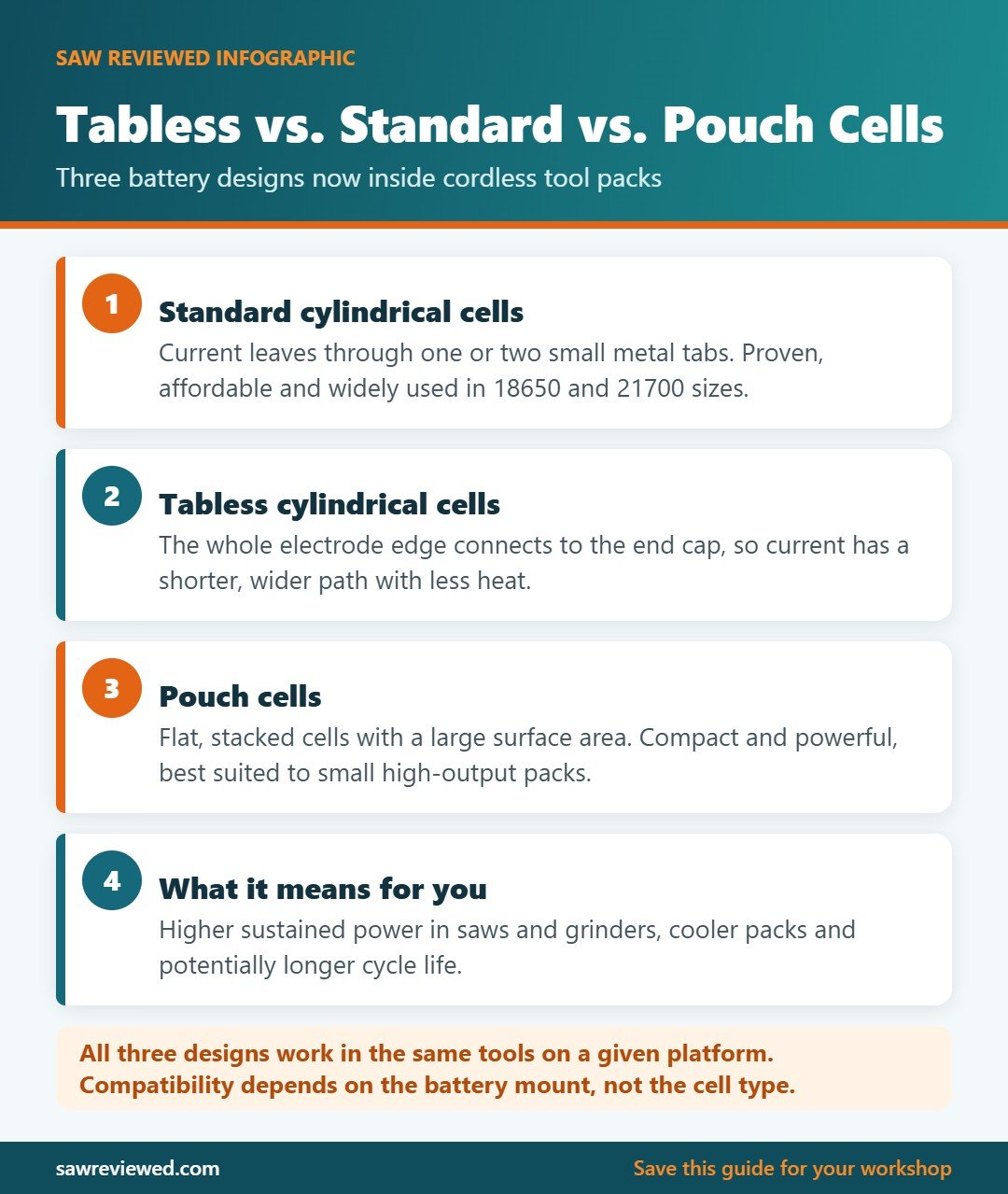
Every cordless tool battery is a group of lithium-ion cells wired together. Inside each cylindrical cell, long strips of electrode material are rolled up like a jelly roll. In a standard design, electricity enters and leaves that roll through one or two thin metal strips called tabs. Those tabs are a bottleneck: current has to travel the length of the electrode to reach them, and the narrow strip heats up under heavy load.
Tabless battery cells remove that bottleneck. Instead of a single tab, the entire edge of the electrode is connected to the end of the can. Current travels a much shorter, wider path. The cell is not truly “without tabs” in a physical sense; it is more accurate to think of it as one giant tab across the whole edge.
Why tabless battery cells matter for saws
Low-draw tools like drills and drivers rarely push a battery to its limits. Saws are different. A cordless circular saw ripping wet framing lumber, a reciprocating saw in demolition, or a miter saw crosscutting hardwood all draw high current for seconds at a time. With standard cells, that load causes voltage sag and heat. The battery management system protects the cells by throttling power, which you feel as the blade slowing down.
Because tabless battery cells waste less energy as heat, they can hold voltage higher for longer. Brands report more sustained power and less thermal shutdown. Metabo HPT, for example, says its tabless T-PWR packs run cooler under demanding applications. That is exactly the scenario where saw users notice a difference.
Which brands use tabless battery cells?
Adoption has moved quickly since 2024. This table summarizes the main platforms; always check current product listings because names and lineups change often.
| Brand | Pack family | Cell type | Notes |
|---|---|---|---|
| Milwaukee | M18 FORGE XC8.0 and HD12.0 | Tabless 21700 | FORGE XC6.0 uses pouch cells instead |
| DeWalt | 20V MAX XR POWERPACK | Tabless 21700 | Launched in 2024; newer XR 5Ah uses tabless 18650 cells |
| Bosch | EXPERT 18V | Tabless | Introduced in early 2026 |
| Festool | 18V 4.0Ah and 8.0Ah | Tabless 21700 | 5.0Ah packs stay on 18650 cells |
| Metabo HPT | T-PWR MultiVolt | Tabless 21700 | Works in 18V and 36V tools |
| Ryobi | ONE+ HP Edge 4Ah | Tabless 21700 | Compatible with all ONE+ tools |
Tabless vs. pouch cells
Pouch cells are the other new design. DeWalt was the first major tool brand to use them with POWERSTACK in 2022, followed by Milwaukee’s FORGE XC6.0. Pouch cells are flat and stacked, which gives a large surface area for current and cooling. They shine in compact packs where you want high output with low weight, such as a 1.7Ah battery on an impact driver.
For larger packs, the industry appears to be leaning toward tabless battery cells. Tool news sites have reported that some higher-capacity pouch packs were phased out while tabless cylindrical packs expanded. Cylindrical cells are easier to manufacture at scale, easier to cool in a big pack and well understood by engineers.
7 facts to check before you upgrade
- Your tools will work. On the same platform, new packs fit existing tools. The mount and electronics decide compatibility, not the cell type.
- Not every tool benefits. Drills, lights and small drivers will feel almost identical. Saws, grinders and big rotary hammers benefit most.
- Price per watt-hour is higher. Compare packs using watt-hours, not just amp-hours. Our watt-hour guide shows the math.
- Your charger matters. Fast chargers can fill tabless packs quicker, but a standard charger works fine.
- Weight is similar. Tabless battery cells do not make packs dramatically lighter; pouch cells are better for that.
- Cold still hurts. Winter reduces runtime for every lithium-ion design. See our cold weather tool batteries guide.
- Buy for your hardest tool. One tabless pack for your saw, plus your existing batteries for everything else, is often the smartest spend.
Do tabless battery cells last longer?
Heat is one of the main things that ages lithium-ion cells. Because tabless battery cells run cooler under the same load, they should age more slowly in demanding use. Some brands advertise longer cycle life, but real-world lifespan depends on how you charge, store and use the pack. Keep packs out of hot vehicles, avoid storing them fully charged for months, and never charge a frozen battery.
FAQ
Are tabless battery cells safer?
Lower heat under load is a safety benefit, but every lithium-ion pack still needs proper charging and storage. Buy genuine packs certified by a recognized testing lab.
Can I put tabless battery cells in an old pack?
Rebuilding packs yourself is not recommended. Cell matching, welding and battery management are critical for safety, and rebuilding usually voids warranties.
Do tabless battery cells charge faster?
They can accept higher charge rates with less heat, so compatible rapid chargers may fill them faster. Charging speed still depends on the charger.
Is it worth replacing all my batteries?
Usually not. Replace one or two packs for your high-drain saws and keep existing batteries for lighter tools.
Tabless battery cells will not make a weak tool strong, but they let good saws work closer to their full potential. Upgrade the pack you use for your hardest cuts first, then decide if the rest of your kit needs it.